
The gusts of early December may blow in cold weather and final exams, but they also carry an impressive slate of Emory holiday concerts.
There are more than a dozen services, shows and gatherings this month, including Christmas, Hannukah and Bodhi celebrations for Christian, Jewish and Buddhist community members.
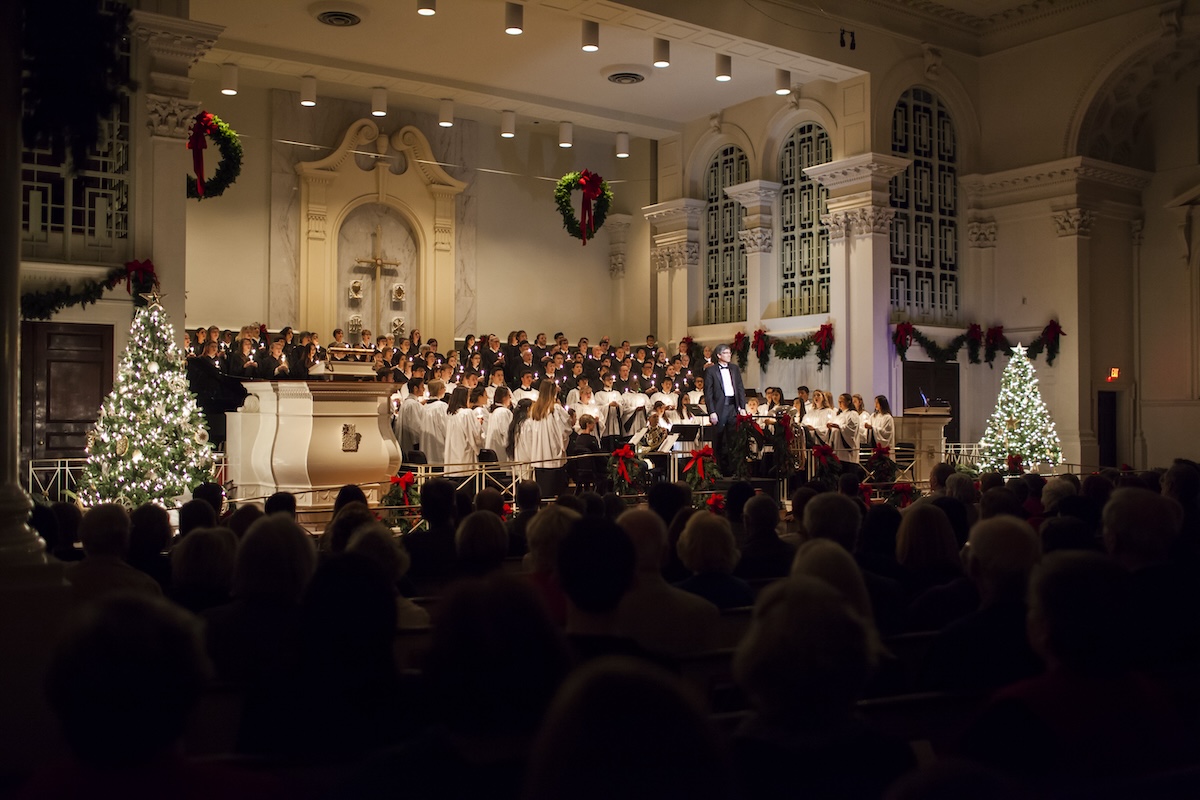
One of the most beloved winter concerts is the annual A Festival of Nine Lessons and Carols. Held at Glenn Memorial United Methodist Church on the Emory campus, the show features sacred music from the Emory Concert Choir and University Chorus accompanied by readings of the Christmas story.
The Concert Choir consists of 40 Emory students, and the 120-person University Chorus includes both students and other community members.
Eric Nelson, Emory professor of music and director of choral studies, has conducted both groups at the concert for 25 years. He says the shows routinely sell out three performances in Glenn Memorial’s 900-seat sanctuary — bringing together nearly 3,000 people across the Atlanta community.
“I’m privileged to be on the podium often, and I conduct a lot of great music,” Nelson says. “But the Lessons and Carols concert is my favorite program of the year.”
This year’s shows take place on Friday, Dec. 5, at 8 p.m. and Saturday, Dec. 6, at 4 and 8 p.m. Check for ticket availability.
Below, Nelson shares what he finds special about the concert and what holiday music means to him.
What is Lessons and Carols?
Lessons and Carols uses a particular format that makes the concert very special. The concept was invented in England around 1935, when a bishop had the idea of interspersing readings from the biblical Christmas story with songs and anthems about Christmas.
At the Emory version of the concert, students, faculty and staff read excerpts from the Christmas story and then the choir sings an anthem or carol in some way related to that part of the story. For instance, one of the readings might be about the manger in Bethlehem, and then we’d sing “Away in a Manger.”
Sometimes we’re all singing, sometimes it’s just the smaller choir, sometimes it’s a cappella — and the accompaniment can be piano, organ, brass or percussion. There’s even a couple carols the audience sings with us.
The concert begins with a solo soprano singing from the balcony, and then the full choir — about 160 singers — walk into the room, each carrying a candle. When they get to the front and everybody’s in their place, we sing an old carol called “Break Forth O Beauteous Heavenly Light.” And all of that symbolizes the light conquering the darkness — and light coming into the world.
Why do you think it has become such a beloved Emory event?
Many people in the community consider this to be the start of the Christmas season, and it’s part of their holiday rhythm.
There is something special about the format and the excellence of the choirs at Emory. Whether one’s faith life aligns with the Christmas story or not, there are big themes going on here — of light and darkness, of new birth bringing hope to the world. In the Bible, angels speak to shepherds of peace on earth, goodwill towards all. Well, we know that there isn’t peace on Earth, and there isn’t goodwill towards all. So, it’s nice to be reminded at Christmas time that we all cling to these hopes.
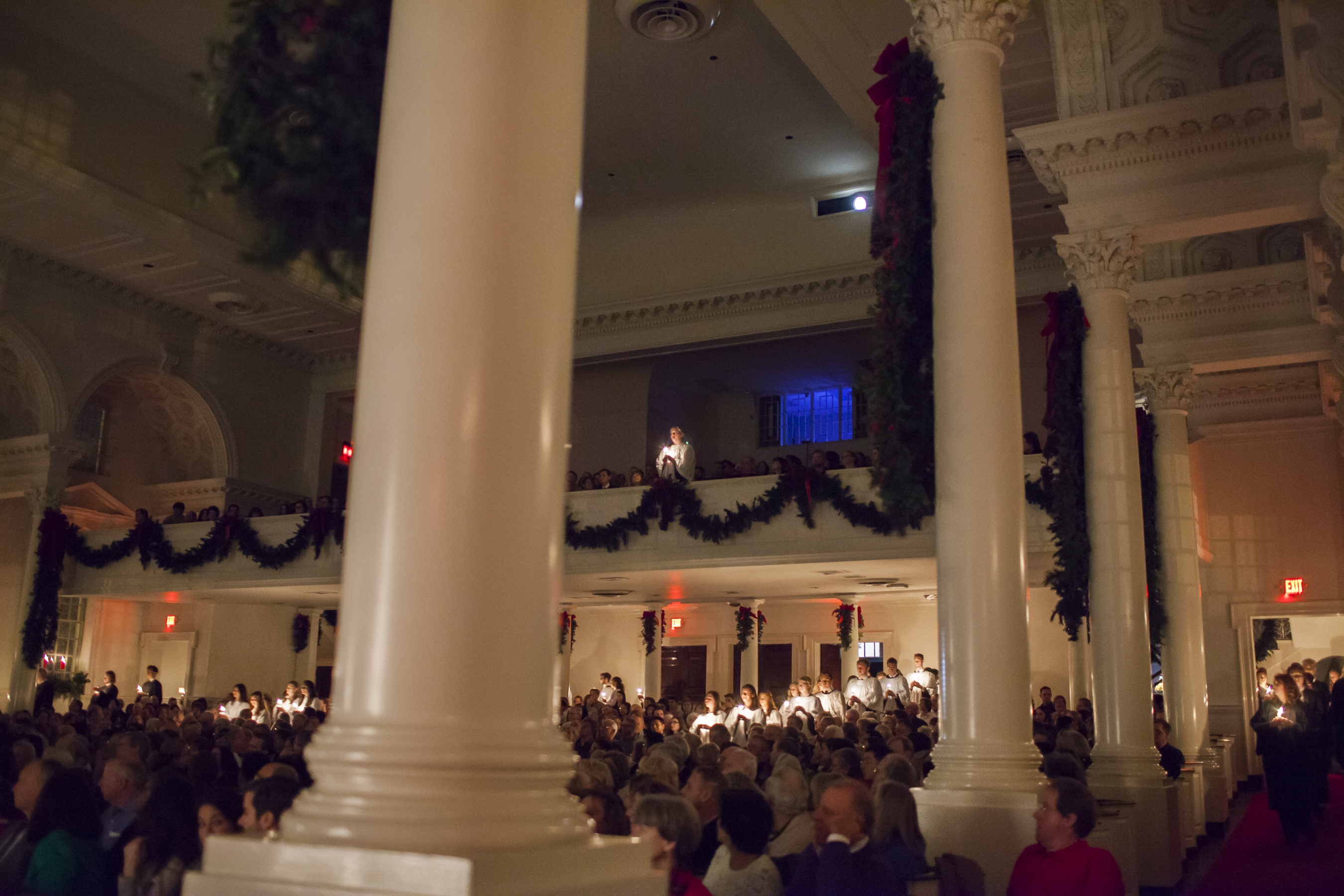
The Lessons and Carols concert begins with a procession of choir members holding lit candles as a soloist sings from above.
Kay Hinton, Emory Photo/Video
What do you like most about the unique format?
I think it’s the big and the small. There are moments when everything cuts loose, and the organ opens up (and the organ in Glenn Memorial is fantastic). There’s something about the sheer power of that. It’s got a kind of exuberance and joy and power that lifts you to a different plane.
And then the quiet moments are amazing. I’ve got to tell you — and this might be surprising — about my favorite moment of the entire concert.
The show ends with “Silent Night.” When the song is over, the choir processes out of the building with each individual carrying their candle, and the lights go very, very dim so that the candles pop. When the last of the 160 singers have left, the technician up in the booth leaves it dark for a good 20 seconds. You are sitting there in silence and reflection without anybody looking at their phone, with no lights blinking — just a thousand people sitting with each other, together. It’s almost holy.
Do you have a favorite carol from the concert?
It’s hard to beat the power of “Hark the Herald Angels Sing.” That’s a carol that we do with the entire audience singing along. I’m on the podium, so I get to stand in the middle of that vortex. And then, like I said, the quiet intimacy of “Silent Night.” It can be a cliché, I suppose, but when we do it, it feels genuine and heartfelt.
Any favorite secular Christmas songs?
You can’t top “Rudolph the Red-Nosed Reindeer,” can you? I like “Jingle Bells,” too. And the softer ones, like “Chestnuts Roasting on an Open Fire.”
I’m a sucker for Christmas, for all of it. The secular stuff, the sacred stuff; the loud stuff, the quiet stuff.
Why is music important to the holiday season?
It’s a really interesting question. Someone should do an honor’s thesis on it.
I don't know, but I think music unlocks things within our souls and brings them to the fore in ways that regular life doesn’t. It gives us a framework to understand and feel things. It’s why people love music, in general. With holiday music, we hear these songs for just one season a year, and then they go away.
When Bing Crosby sings the lyrics “I’m dreaming of a white Christmas,” whether you grew up in the North with snow or not, there’s that sense of nostalgia and whimsy and hoping for something you don’t have. And then with “I’ll be Home for Christmas,” you’re thinking about your own Christmases back when you were home.
I grew up with white Christmases in the city of Erie, which is on Lake Erie in the upper left corner of Pennsylvania. I spent most of my young years shoveling snow. Being in Georgia, I don’t think I actually miss the snow, but I do have nostalgia for it.
There is a special place in my heart for the things I’m conducting now that I sang when I was a teenager. And for the most part, the feelings only deepen with time as you live more life and have more experiences.
Every one of these songs stands the test of time and brings something to us that we need. And once a year, we remember that we need it.