
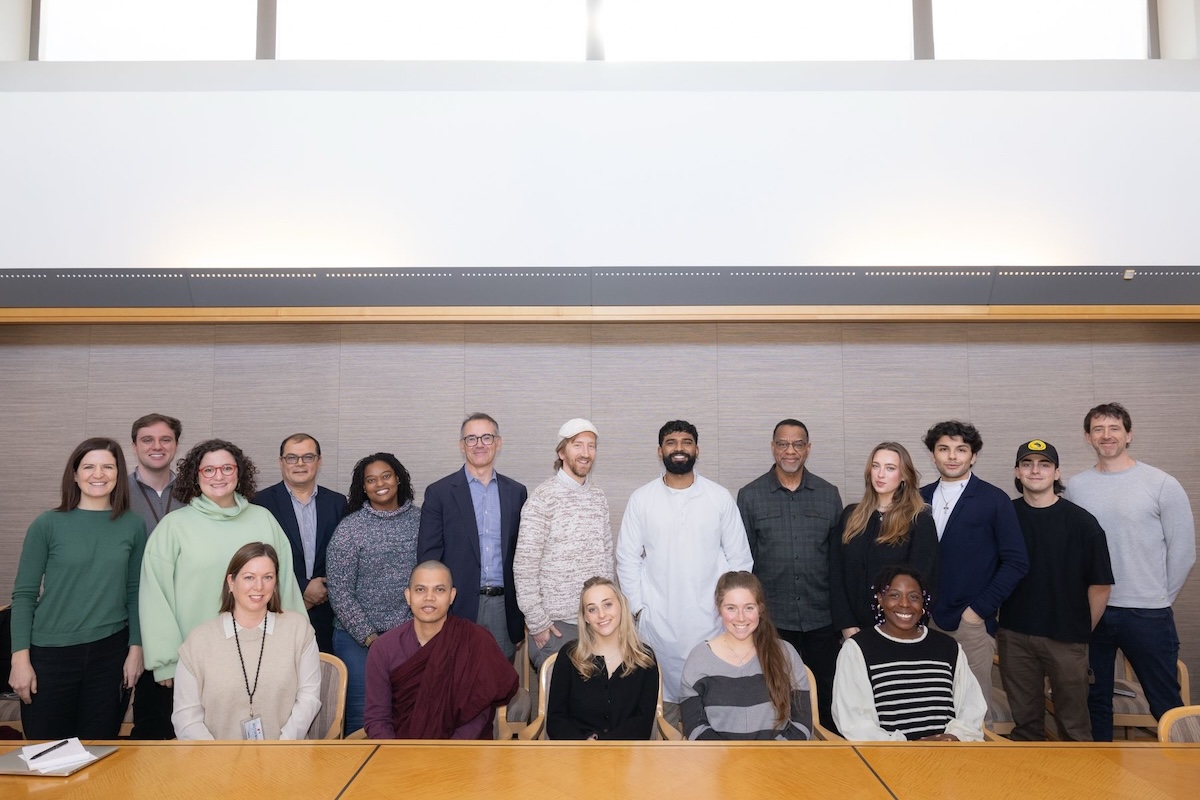
Six Emory students and seven Emory chaplains recently traveled to Washington, D.C., for an interfaith learning experience at the United States Holocaust Memorial Museum.
The delegation, which also included local religious leaders and Emory staff, was selected to participate in the museum’s Interfaith Groups Program. The initiative helps foster productive dialogue across religions through the historical lessons and legacies of the Holocaust and ongoing instances of discrimination and prejudice.
“The Holocaust was a singular event that had such a devastating effect on, particularly the Jewish community, but other communities as well,” says the Rev. Gregory McGonigle, university chaplain and dean of religious life.
“The museum, and the whole Interfaith Groups Program, offers deep religious and philosophical reflection on how humanity could perpetrate these atrocities, and it asks what we need to learn from them for the future.”
The trip was sponsored by Emory’s Office of Spiritual and Religious Life, and students from several faith backgrounds participated.
Emory Rabbi Jordan Braunig says the visit to the museum was especially meaningful to the Jewish students but also provided a foundation for robust interfaith discussions.
“Remembrance of the Holocaust can be a major part of people’s Jewish identity,” he says. “The imperative to remember is baked in from our youngest years.
“But there is a potential for every community to hold its trauma and its sadness alone, and this trip was a reminder that we can share our burdens and share some of the heaviness, grief and loss that we all feel. People from different faith communities can help bear each other’s loads.”
In that spirit of communal support, all Emory chaplains from the Office of Spiritual and Religious Life on both Atlanta and Oxford campus made the trip.
Leaning on each other
As part of the program, the group received a private tour of the museum, met with scholars, screened two films and and held daily debriefings to share reflections on what they learned.
Evie Kirshner, a junior Middle Eastern studies major from New Jersey, says she appreciated the way the group came together after taking in such difficult information.
“With seven chaplains in the room, there was no want for processing,” Braunig says.
Kirshner is an active member of Emory’s MEOR chapter, which is one of several Jewish student groups on campus. Last year, she served on the Inter-Religious Council, a program of the Office of Spiritual and Religious Life that fosters interfaith dialogue among students.
“For me, the point of the trip was allyship, being there for each other, and caring about each other’s histories,” Kirshner says. “I love religion, and I have a lot of respect for everyone who loves their religion. Feeling support from other people — and knowing that you can return it — makes carrying the burden of loneliness, of being away from home, that much easier.”
Cece York, a junior majoring in international studies and religion and philosophy, also joined the trip. She is a member of Emory’s Reformed University Fellowship, a student organization that fosters Christian community on campus.
As someone who is Black and Christian, she says she was moved by the group’s interfaith solidarity.
“Looking at people with compassion and care is central to any moral leadership,” says York, from Mobile, Alabama. “For me, interfaith dialogue means offering a space to listen. It regifts dignity to people who have lost their own dignity, whether through harmful stereotypes or dehumanization. The intention is to remove the mystery and to sit with one another.”
McGonigle says that’s exactly the kind of reflection he hoped the visit to the museum would inspire.
“We lead trips to sites that explore issues of moral crisis to better understand our role as moral agents, and to reflect on what it means to live a good life and respond to crises as they arise,” he says. “It’s an important part of the ethical and character development opportunities we seek to provide to students through the chaplaincy.”
Paying it forward
As part of the Interfaith Groups Program, the Emory delegation is responsible for hosting an event over the next year that inspires connection in its community through the lens of Holocaust history.
The idea, Braunig explains, is that the experience doesn’t end when the group boards a plane back to Atlanta. Instead, the work “to recognize our shared humanity” continues.
Inspired by the Inter-Religious Council’s weekly dinner, Kirshner hopes to bring people from across faith backgrounds together for meals on campus. One idea she’s had is joint dinners for Jewish and Muslim students during their coinciding holidays of Purim and Ramadan.
Kirshner — who volunteers at a local synagogue — says she grew up in primarily Jewish spaces, and hearing fellow Emory students share their own reflections on the Holocaust was “deeply meaningful to me.”
She wants to pay that respect forward by continuing to participate in “interfaith initiatives and showing allyship in daily life.”
Remembering today — and tomorrow
Tuesday, Jan. 27, was National Holocaust Remembrance Day, and the chaplaincy, along with the Tam Institute for Jewish Studies and several campus Jewish communities, hosted an event with keynote speaker Hershel Greenblat, a Holocaust survivor who lives in the Atlanta area.
Attendees from the museum trip also shared takeaways and reflections at the event.
“We’re at a transition point with the history around the Holocaust, where the generation that survived is dwindling,” Braunig says. “It’s incumbent upon us to find a way to carry these stories forward and to share with new generations the tragedy — the unimaginable and unspeakable violence — but also the resilience and stories of survival, how people were able to forge new lives in the aftermath of so much trauma.”
York attended last year’s Holocaust Remembrance Day event, headlined by another survivor named George Rishfeld.
“It was very powerful,” she says of Rishfeld’s story, which sparked her interest in Holocaust history. She and a few other students continued to meet with Rishfeld in the weeks following his speech to hear more about his life experiences.
“As a descendent of people of slavery, I can’t hear direct accounts from people of that time,” York says. “And having the opportunity to listen to a Holocaust survivor, I couldn’t pass that up. I wanted to learn more about it and hear a story of resilience.”
The experience inspired her to research firsthand accounts, collected in the 1930s, of former enslaved people in the South.
“Being at Emory, I have access to resources that let me read direct accounts of actual lived experiences and retellings,” she says. “I’m incorporating those into my research and seeking out more individual storytelling.
“I encourage people to be curious and seek out new learning opportunities,” York adds. “That’s what propelled me to my first Holocaust Remembrance Day Event. And I will be there again this year.”