For Emory scientists, the path from discovery to development can be challenging. After a breakthrough in the academic lab, technologies must get across what’s known as the Valley of Death — the period between discovery and clinical validation where investor funding can be difficult to attract. Many promising innovations stall or fail here, often due to lack of funding and support.
The Emory Drug Development Fund (EDDF) was created to bridge these gaps for promising therapeutics: drugs intended to treat disease.
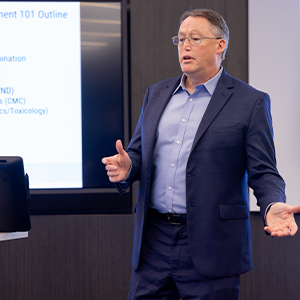
“I joke that we’re Emory’s best-kept secret,” says EDDF managing director Doug Gooding, who joined the fund in June as its first full-time hire after working for the fund as a consultant. “Every now and again, we'll find out about a potential drug candidate that's been kicking around for quite a while, but the principal investigators who were involved weren’t aware that we existed.”
Now, with millions under management and a goal to invest in therapeutic innovations that improve human health, EDDF is ready to step into the spotlight.
Investing in a path to the clinic
EDDF provides funding and drug development expertise to Emory therapeutic innovators to reach key development milestones, such as optimizing and selecting lead candidates, conducting Investigational New Drug (IND)-enabling studies, and preparing for clinical testing. Each investment aims to make the core technology more attractive for additional funding and development.
Emory already has a strong track record in developing lifesaving therapeutics — in fact, the university ranks as the third top contributor of FDA-approved drugs and vaccines in the world among public institutions over four decades, only behind the NIH and the entire University of California system. Major successes include the COVID-19 drug LAGEVRIO (molnupiravir) and the HIV antiretrovirals lamivudine and emtricitabine.
But, Gooding says, “Emory is more than just antivirals. This fund is intended to catalyze other therapeutic opportunities with the potential for long-term success.”
To find those promising innovations, EDDF looks across the university, from the School of Medicine to the Emory College of Arts and Sciences chemistry and biochemistry departments and beyond.
EDDF has been invaluable for securing external funding, providing guidance with regard to drug advancement, and reviewing intellectual property — and helped us move much more efficiently towards testing in human subjects. We expect to begin clinical trials in 2026.
The Sorscher lab investment is unique in that it’s directed at a pre-company investment stage — a departure from the way many venture investment vehicles operate. Additionally, the opportunity has attracted significant third-party funds to increase the scale of support and what can be achieved. Finally, those dollars are helping the Sorscher lab get close to an IND application, a key milestone to move from preclinical to clinical development. Getting to a human clinical study within the university setting, Gooding says, would be very unique relative to other universities.
As for the impact of the fund’s investment: “We have used resources from EDDF, along with external support from NIH, the CF Foundation and other sources, to conduct analytics, perform extensive medicinal chemistry optimization, advance drug formulation, complete IND-enabling animal studies and establish chemistry, manufacturing and controls aspects of a novel drug series directed towards IND submission,” says Sorscher. “EDDF has been invaluable for securing external funding, providing guidance with regard to drug advancement, and reviewing intellectual property — and has helped us move much more efficiently towards testing in human subjects. We expect to begin clinical trials in 2026.”
Collaboration for more innovation
Part of a larger ecosystem, EDDF operates alongside Drug Innovation Ventures at Emory (DRIVE) and the Emory BioFoundry Institute (EBFI). All three organizations fall under the umbrella of Emory Innovations, Inc. (EII), a wholly owned subsidiary of Emory University functioning as a holding company for innovative, non-academic, and high-impact activities.
“EII and its operating units leverage Emory’s strengths in innovative research to create value and support Emory's mission to apply knowledge in the service of humanity,” says Michael Cassidy, executive director of EII.
While Emory’s Office of Technology Transfer supports licensing, EII’s operating units provide business and translational support for moving research forward. DRIVE focuses on developing antivirals; EBFI accelerates devices, diagnostics and health care IT. EDDF, meanwhile, invests directly in therapeutic intellectual property developed by Emory faculty.
But the uniting factor for all three entities lies in their commitment to advance Emory intellectual property — providing funding specifically for research in hopes of making technologies more attractive for future institutional investment on a larger scale.
Looking ahead
As awareness of the fund grows, Gooding hopes more faculty will view EDDF as an early-stage partner. In addition to financial support, the fund offers principal investigators expertise and connections they might not otherwise access easily.
Learn more about Emory’s innovation ecosystem on the Emory Entrepreneurship and Innovation website.
Supporting the next generation of entrepreneurs
When he’s not supporting therapeutics research through the Emory Drug Development Fund, Doug Gooding teaches a graduate course on how science becomes business.
This fall, he launched a 10-week course for PhDs, postdocs and other graduate programs from Emory, Georgia Tech, and Georgia State, co-sponsored by the Goizueta Business School and Nucleate Atlanta. The class explores entrepreneurship, venture investing and drug development strategy, pairing weekly lectures with interviews featuring biotech founders and investors on a national stage.
“The interview piece has been very well-received. I choose entrepreneurs who have been founders of companies, particularly those who have made successful exits and who have also worked in investing and operational capacities,” says Gooding.
More than 100 students registered for the hybrid course, with 20-40 attending in person each week. Gooding hopes to offer the course either on an annual or per-semester basis to help build Atlanta’s life sciences talent pipeline.
“I get to introduce the students to this universe they can work in if they don’t want to go the academic route after they graduate,” he says. “It’s been a ton of fun.”
Photo by Avery D. Spalding, Emory Photo/Video.