
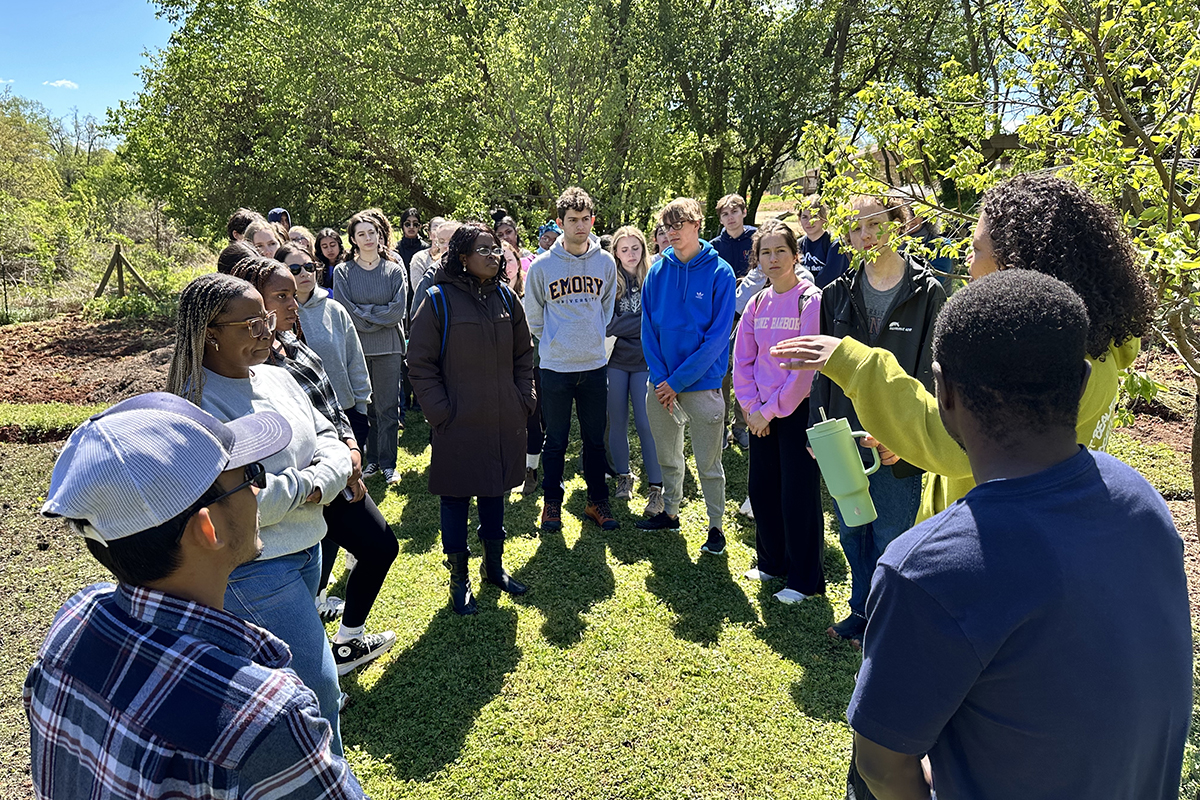
Emory University has received the 2026 Carnegie Community Engagement Classification from the American Council on Education and Carnegie Foundation for the Advancement of Teaching. Emory is one of 237 U.S. colleges and universities so honored this year, according to the foundation. Emory also received Community Engagement Classification in 2015 and in 2006, when it was among the first U.S. universities recognized.
“Higher education is a vital economic engine for us all. Our colleges and universities not only fuel science and innovation, they build prosperity in rural, urban and suburban communities nationwide,” said Timothy F.C. Knowles, president of the Carnegie Foundation. “We celebrate each of these institutions, particularly their dedication to partnering with their neighbors — fostering civic engagement, building useable knowledge, and catalyzing real-world learning experiences for students.”
The Carnegie Foundation’s Community Engagement Classification recognizes Emory’s demonstrated commitment to advancing knowledge in the service of humanity, according to Badia Ahad, provost and executive vice president for academic affairs.
“This recognition reflects a broad swath of programs, classes, research and engagement opportunities that connect our faculty, staff and students with neighbors and partners in the Atlanta metro area, the state of Georgia and beyond to work toward the good of all,” Ahad adds. “We are honored to receive once again this important recognition as one of the nation’s leading community-engaged universities.”
In its application for the Carnegie Elective Classification, Emory highlighted its significant community engagement initiatives over a representative period of one year. (Since the application was written primarily during 2024 for submission in early 2025, figures referenced are from the prior academic year, which ended Aug. 31, 2023.) Highlights include:
- A spirit of service, with 83% of Emory students involved in service during the 2022-23 academic year. These students combined efforts with university employees to perform 44,000 hours of community service hours that year.
- Commitment to community-benefitting scholarship carried out by faculty, staff, students and community partners, demonstrated by publications and professional presentations from across the university, such as an article focused on Atlanta residents’ knowledge around heavy metal exposures and remediation in urban agriculture.
- The integration of coursework and community engagement, where 3,346 students were enrolled across 155 community-engaged teaching and learning courses during the 2022-23 academic year.
- A focus on civic engagement, including Emory’s designation as a DeKalb County polling site since May 2022 and substantial gains in student voting rates, rising from 17.9% in 2014 to 44.8% in 2018.
- Commitment to the Atlanta community’s well-being, demonstrated by Emory’s Woodruff Health Sciences Center, which provided $579.4 million in community benefit during a single fiscal year (2023), including an estimated $111.9 million in indigent and catastrophic care provided by Emory Healthcare to patients who were unable to pay. In total, the research, education and health care missions have a $14.8 billion economic impact on metro Atlanta.
- Prioritizing economic mobility and entrepreneurship through Goizueta Business School’s involvement with the Start:ME Accelerator program, which has served 514 neighborhood businesses, created or retained more than 1,000 jobs and driven more than $33 million in annual revenue, as of the latest impact summary.
- A global mindset, leading to Emory faculty engaging in 168 countries through 307 partnership agreements, as of 2023.
Unlike the Carnegie Foundation’s other classifications, which rely on national data, Community Engagement is elective. Institutions choose to participate by conducting a year-long, university-wide self-study examining the nature and extent of their community engagement. This approach allows the foundation to address elements of institutional mission and distinctiveness that are not represented in the national data on colleges and universities.
Emory’s application process was coordinated by representatives of the Offices of the President, Provost, Government and Community Affairs with extensive support from a team of community partners, faculty and staff from all nine schools, and student representatives. More information about the process and partners is available on the Office of the Provost website.