

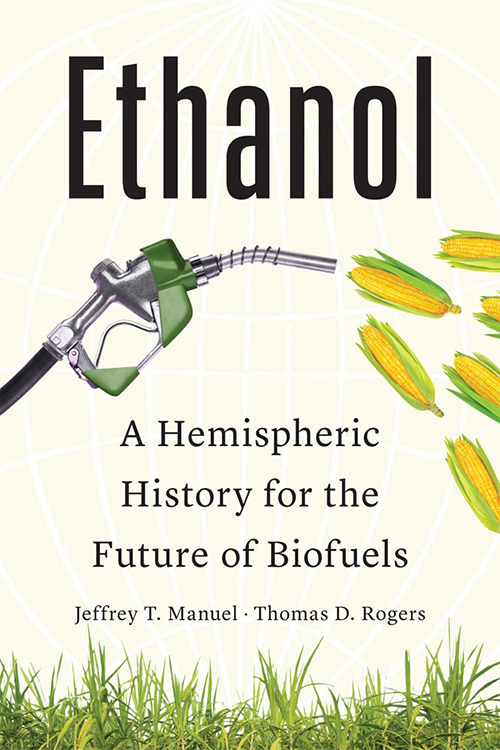
Courtesy of The University of Oklahoma Press
Tom Rogers, professor of labor and environmental history in Emory College of Arts and Sciences, explores some of those questions in his new book, “Ethanol: A Hemispheric History for the Future of Biofuels,” co-authored with Jeffrey Manuel.
In this Q&A, Rogers discusses his research on Brazil and how understanding ethanol’s transnational history can explain the fuel’s capacity as a renewable energy source. Answers have been edited for clarity and length.
What initially sparked your research interest in Brazil and, later, ethanol and its history?
I went to Brazil. For my graduate program, I needed to learn Portuguese. Because I was learning the language, I started to read more of the history that hadn't been translated into English or produced here.
Brazil accounts for half of the sugar that gets bought around the world, but even with that kind of dominance, half of the sugar cane is not going into making sugar. It makes fuel that people can drive around on. I became really interested in ethanol, and my colleague Danny LaChance [associate professor of history], introduced me to Jeff Manuel, who teaches at Southern Illinois University. Jeff wanted to do a history of U.S. ethanol production. We realized that ethanol’s development is a transnational story, and if it’s the same story, maybe we should tell it together.
Some people believe that ethanol is a more climate-friendly alternative to gasoline. Why is that a misconception?
We went into this project thinking that, among other things, we were going to achieve some clean answers to questions like that. It turns out that there are not actually neat answers, which makes the book interesting and complex.
Most environmental organizations will tell you that ethanol is terrible. Vast monocultural corn cultivation in the United States is not good for our ecosystems. On the other hand, if you’re measuring ethanol against petroleum products, those products are environmental threats as well. We found that a lot of people say ethanol might be treated as a bridge fuel for energy transition.
On an emissions basis, ethanol is better than gasoline, but emissions don’t capture all of the environmental impacts. One of the main sources of contention between the ethanol industry and its opponents, for instance, is how to measure land use impacts. It’s highly political, and that can be analyzed.
Why do the United States and Brazil produce so much of the world’s ethanol supply, as opposed to other countries? What factors drive their success in production?
It’s partly that the United States and Brazil already held big sectors in ethanol-creating crops: corn for the U.S. and sugar cane for Brazil. Any industry wants co-products that it can mix and match, then sell and maximize market advantage.
It’s also not incidental that these are two of the countries with the largest arable potential in the world. They’ve got more farmland than anywhere else and produce something like 88% of the world’s ethanol. At the same time, they have pursued the creation of a global market.
With new biofuels in development, what is the relationship between the U.S. and Brazil’s ethanol production like today? How have recent sanctions and tariffs impacted that relationship?
The United States had a tariff against Brazilian ethanol that made it impractical for Brazil to export ethanol into the United States. That only ended in 2011. The most recent tariffs have probably not really affected the ethanol industry because in Brazil, they’re mainly consuming their own ethanol.
How do you bring your research into the courses that you teach on campus?
There have been real moments of biofuel expansion that have come at the expense of keeping up with food production. There was a spur in biofuel production in the late 2000s that started to create commodity price spikes and made it harder for people to eat. The World Bank famously leaked a memo about that in 2008. Those episodes are important to my course, “The History of Hunger,” and I draw directly on my research to bring them in.
What facts or statistics came up in your research that surprised you?
What surprised Jeff and me was how consistently interlinked the United States and Brazil were as the biofuel industry grew in both places. We talked to the former minister of agriculture in Brazil. It didn’t surprise us at all that he was buddies with U.S. politicians and that he'd hosted them at his place — he’s a global politician. But then you get down to the individual farmer level and see that they have these connections, too. They’ve got a network of Brazilian friends and vice versa.
It was the volume and consistency of the connections that surprised us.