


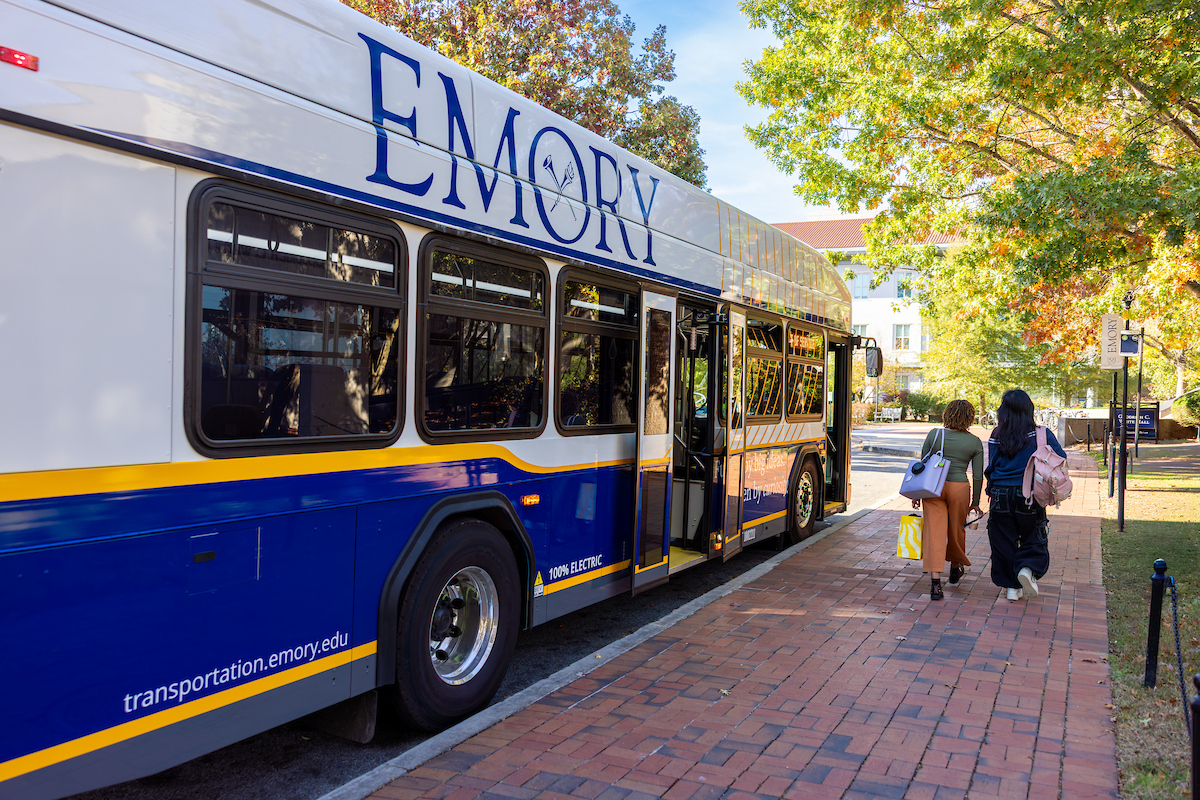
If you don’t listen closely, it would be easy to miss that six battery electric buses have been added to the Emory shuttles fleet.
Softly chugging along, they’ve traveled a long road to make it to Emory University’s commuter routes.
“We started this process multiple years ago, from the feasibility studies to procurement to eventually getting them on the road,” says Walter Kolis, assistant director of transportation services. “Every bus is custom-built and considers hundreds of specifications about your campus, operators, safety and more. It takes a lot of time.”
Even so, it’s worth the effort.
“The switch to battery-powered buses will definitely help us to reduce emissions, and the user experience is better, too, because the ride is much quieter and smoother,” says Kolis. “Other than that, there’s almost no change to the user experience because the seating, climate control and all the interior features are exactly the same.”
There is one simple way to know you’re about to step onto an electric bus, though: they’re all numbered 500.
Kolis is also quick to point out that Emory’s shuttle operations aren’t the standard campus fare.
“We go all around the city and connecting the pieces of the Emory enterprise together,” he says. “Whether people have appointments at Emory Healthcare or need to get from their car to the office and class or are traveling between campuses, it can be surprising how extensive the network is.”
In fact, the routes are so extensive that Emory’s Transportation and Parking Services had to collaborate with every fire department that these routes pass through (such as City of Atlanta, Fulton County and DeKalb County), thanks to the large batteries.
It also presented an opportunity. Because of how sprawling the shuttle routes are, the team realized that “these are basically rolling billboards.” Combining the heart of Emory’s work with expert design choices brought the buses to life.
“We wanted to maintain the distinct Emory brand and style, but showcase what we do in an exciting way,” explains Kolis on his work with Emory’s design team.
Emory’s passion for sustainability
Those who were at Emory in the early 2000s might remember that this isn’t the first time some of the shuttles have gone electric. Emory had an agreement with Georgia Regional Transit Authority to lease five electric buses in 2003. Due to charging issues and limited capacity, the remaining buses were sent to Chattanooga in 2009 — where they’re still being used on the CARTA free downtown shuttle.
With the success of the new battery-powered buses, are there plans to upgrade the rest of the fleet?
Not at this point, says Kolis.
That question was part of the feasibility study, too. An all-electric fleet would increase the number of buses by 53%, the number of non-revenue hours (when buses are running but not serving customers) by 132%, and would have required swapping out vehicles 66 times per day to allow for charging. Not to mention the need for additional mechanics, charging stations and storage space to keep the vehicles in top shape.
In other words: moving to a fleet with only more sustainable vehicles would, counterintuitively, be the less sustainable choice.
But that thoroughly considered answer is one of the things that makes the Transportation and Parking Services team most proud.
“We’re excited that we made the best data-informed choice, incorporating economic and sustainability goals. We’ve avoided some of the pitfalls we’ve seen other institutions experience by proceeding cautiously, looking at the data, and making the best choice for Emory,” Kolis says.
This long-standing dedication and strategic partnerships haven’t gone unnoticed. The university was recognized by the Association for Commuter Transportation with a national award for Transportation Demand Excellence (TDM) in the Higher Education category.
“Emory University’s strong collaboration with regional partners, transit agencies, sustainability offices, human resources, local government and student/university governance demonstrate how to build cross-sector coalitions to advance TDM goals,” said the Association for Commuter Transportation when presenting the award.
And for anyone who has ridden Emory’s shuttles, it’s clear that hard work continues to pay off.