
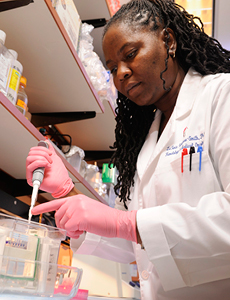
More cell lines in the freezer could mean more options, eventually, for women with a hard-to-treat form of breast cancer. That’s the idea behind LaTonia Taliaferro-Smith’s plans to generate more basic materials for scientists working on triple-negative breast cancer.
These aggressive tumors strike women an average of two decades earlier than other forms of breast cancer and can return quickly after chemotherapy. The triple-negative label refers to the tumor’s lack of three biologic markers that make other breast cancers vulnerable to standard drugs such as tamoxifen or Herceptin. Triple-negative breast cancers disproportionally affect African American women and contribute to their higher rate of breast cancer mortality, according to Emory studies.
Taliaferro-Smith, a researcher at Emory’s Winship Cancer Institute, ran into a problem when she began pursuing new targets for drugs that fight triple-negative breast cancers. “The idea is to have a representative set of cell lines, but there are very few cell lines from African American donors,” she says. She wants to remedy that problem by making Winship “a go-to resource nationwide for researchers working on triple-negative.”